RAG 入门 — 简明指南
RAG 简明解释:检索增强生成让 AI 基于你的文档回答。了解 pipeline、适用场景与初学者常见坑,再决定是否上向量库。
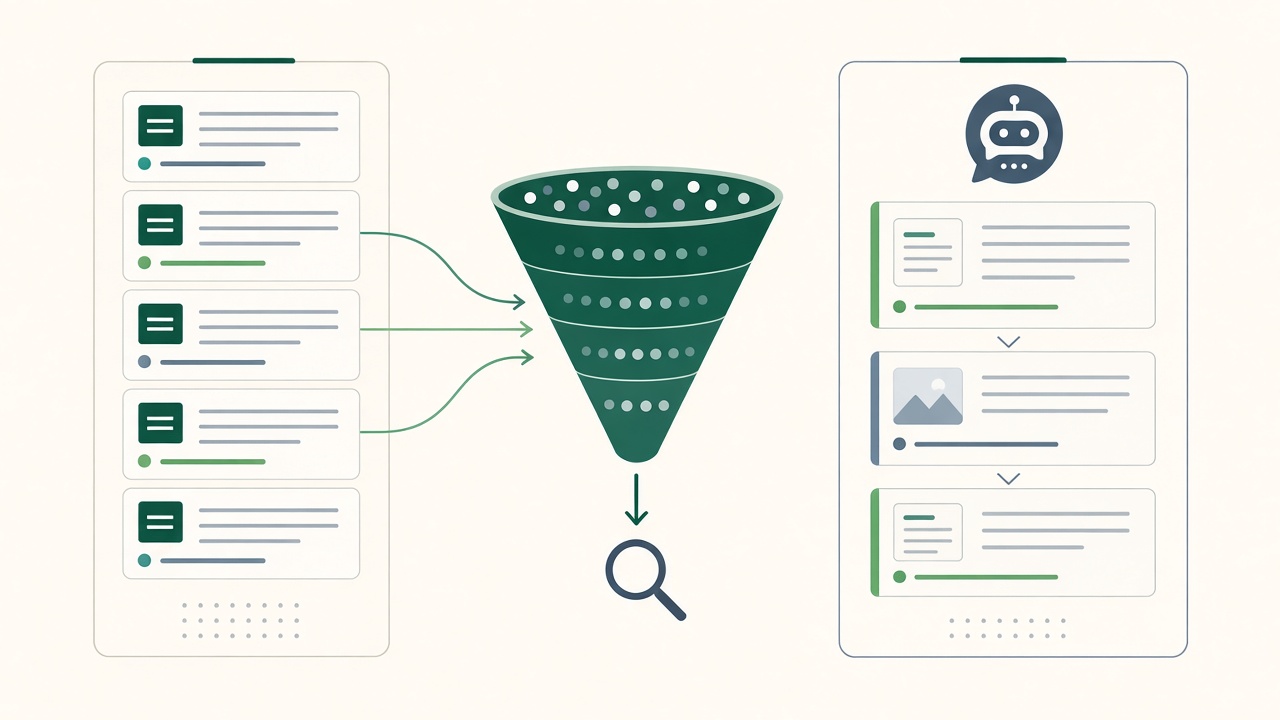
什么是 RAG?
Support kept answering the same policy questions with slightly wrong details — the model “remembered” old blog posts that contradicted the official handbook. RAG explained in practice meant searching the handbook first, then answering only from those snippets. Accuracy jumped without retraining anything.
RAG(检索增强生成):先搜文档,再让模型基于片段回答。减少公司知识、文档与政策场景下的幻觉。
Why RAG 入门 解释 Matters
RAG 是 AI 集群 mid-funnel 关键词。清晰入门文增加主题深度。
The Story Behind RAG 入门 解释
The problem RAG solves
Large language models improvise when they lack grounded context. For company policies, product docs, and internal wikis, improvisation looks like confident wrong answers. Retrieval-augmented generation fixes the grounding step: find relevant passages, then generate an answer constrained by those passages.
RAG is not magic search. It is a pipeline: chunk documents, retrieve top matches for a question, inject them into the prompt, and instruct the model to cite or refuse when evidence is missing.
Beginners hear “vector database” and overbuild. Often keyword search plus good chunking plus strict prompting teaches the pattern faster than infrastructure cosplay.
Pipeline pieces in plain English
Chunk documents into passages small enough to fit context windows but large enough to preserve meaning — often a few paragraphs, not whole PDFs.
Retrieve with embeddings and vector search or with keyword search for structured FAQs. Top-k passages (often three to five) feed the prompt.
Prompt the model: answer only from provided sections; quote or cite chunk IDs; say “not found” if evidence is insufficient. That instruction is half the battle.
- Chunk → index → retrieve top-k
- Prompt with passages + citation rules
- Evaluate with real user questions
- Iterate chunk size and retrieval before scaling infra
Hands-on learning without overengineering
Collect ten FAQs your team actually asks. Split source docs into sections manually if needed. For each question, pick the three best sections by hand first — you are learning relevance intuition.
Automate retrieval next with simple search. Compare automated picks to your manual picks. Where they diverge, fix chunk boundaries or headings.
Measure accuracy on the ten-question set before adding agents, fancy rerankers, or multi-hop reasoning. RAG quality gates everything downstream.
RAG versus bigger prompts and versus fine-tuning
If all knowledge fits in one context window and changes rarely, a big prompt may suffice. RAG wins when knowledge is large, updates often, or must be auditable via citations.
Fine-tuning changes model weights and is costly to refresh. RAG keeps the model fixed and updates docs independently — better for policies and product catalogs that change weekly.
After this guide, deepen prompt engineering and automation on Sturdee — RAG is retrieval discipline plus prompts, not a separate religion.
RAG 流程通俗讲
- 文档切分为 passage
- 嵌入或关键词检索
- 把 top 片段塞进提示
- 要求引用 chunk ID
- 用真实用户问题集评估
何时用 RAG vs 更长提示词
- 收集 10 个想回答的 FAQ
- 文档切成小段
- 每问检索 top 3 段
- 提示:仅据片段回答;缺失则说明
- 复杂基础设施前先测准确率
常见 RAG 错误
- chunk 过大或过小
- 不要求引用
- 未测查询就信任检索
- RAG 质量未好就上智能体
下一步学应用 AI
读完本文后学提示词工程与 AI 自动化 — RAG = 提示词 + 检索纪律。
Takeaways — What to Do Next
RAG explained for beginners is retrieve-then-generate with citations: chunk docs, fetch top passages, constrain answers, evaluate on real questions. Master that loop before vector databases become a hobby.
RAG — 常见问题
Frequently Asked Questions
RAG 等于微调吗?+
不等。微调改权重。RAG 固定模型,提问时喂相关文档。
学 RAG 必须向量数据库吗?+
不必先上。关键词搜索足以建立 retrieve-then-generate 习惯。
继续互动学习
/learn/ai →