RAG Explained for Beginners — Simple Guide
RAG explained simply: retrieval-augmented generation lets AI answer with your docs. Learn the pipeline, use cases, and beginner pitfalls.
What Is RAG?
Support kept answering the same policy questions with slightly wrong details — the model “remembered” old blog posts that contradicted the official handbook. RAG explained in practice meant searching the handbook first, then answering only from those snippets. Accuracy jumped without retraining anything.
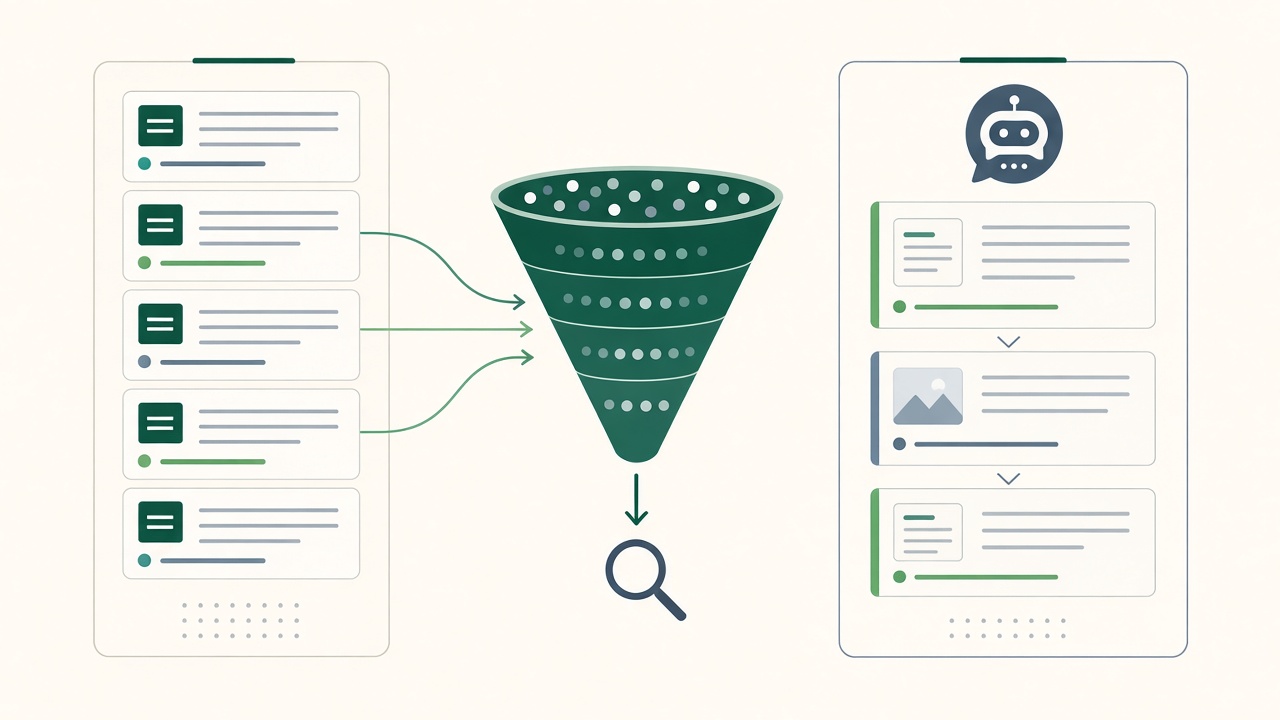
RAG (retrieval-augmented generation) means: search your documents first, then ask the model to answer using those snippets. It reduces hallucinations for company knowledge, docs, and policies.
Why RAG explained for beginners Matters
RAG is a mid-funnel AI keyword. Clear beginner explainers build topical depth for the AI cluster.
The Story Behind RAG explained for beginners
The problem RAG solves
Large language models improvise when they lack grounded context. For company policies, product docs, and internal wikis, improvisation looks like confident wrong answers. Retrieval-augmented generation fixes the grounding step: find relevant passages, then generate an answer constrained by those passages.
RAG is not magic search. It is a pipeline: chunk documents, retrieve top matches for a question, inject them into the prompt, and instruct the model to cite or refuse when evidence is missing.
Beginners hear “vector database” and overbuild. Often keyword search plus good chunking plus strict prompting teaches the pattern faster than infrastructure cosplay.
Pipeline pieces in plain English
Chunk documents into passages small enough to fit context windows but large enough to preserve meaning — often a few paragraphs, not whole PDFs.
Retrieve with embeddings and vector search or with keyword search for structured FAQs. Top-k passages (often three to five) feed the prompt.
Prompt the model: answer only from provided sections; quote or cite chunk IDs; say “not found” if evidence is insufficient. That instruction is half the battle.
- Chunk → index → retrieve top-k
- Prompt with passages + citation rules
- Evaluate with real user questions
- Iterate chunk size and retrieval before scaling infra
Hands-on learning without overengineering
Collect ten FAQs your team actually asks. Split source docs into sections manually if needed. For each question, pick the three best sections by hand first — you are learning relevance intuition.
Automate retrieval next with simple search. Compare automated picks to your manual picks. Where they diverge, fix chunk boundaries or headings.
Measure accuracy on the ten-question set before adding agents, fancy rerankers, or multi-hop reasoning. RAG quality gates everything downstream.
RAG versus bigger prompts and versus fine-tuning
If all knowledge fits in one context window and changes rarely, a big prompt may suffice. RAG wins when knowledge is large, updates often, or must be auditable via citations.
Fine-tuning changes model weights and is costly to refresh. RAG keeps the model fixed and updates docs independently — better for policies and product catalogs that change weekly.
After this guide, deepen prompt engineering and automation on Sturdee — RAG is retrieval discipline plus prompts, not a separate religion.
RAG Pipeline in Plain English
- Chunk documents into passages
- Embed or keyword-search for relevance
- Stuff top chunks into the prompt
- Require citations to chunk IDs
- Evaluate with question sets from real users
When to Use RAG vs a Bigger Prompt
- Collect 10 FAQs you want answered
- Split your docs into small sections
- Retrieve the top 3 sections per question
- Prompt: answer only from sections; say if missing
- Measure accuracy before adding fancy infra
Common RAG Mistakes
- Chunks too large or too small
- No citation requirement
- Trusting retrieval without testing queries
- Building agents before RAG quality is good
Learn Applied AI Next
After this guide, study prompt engineering and AI automation paths — RAG is prompts + retrieval discipline.
Takeaways — What to Do Next
RAG explained for beginners is retrieve-then-generate with citations: chunk docs, fetch top passages, constrain answers, evaluate on real questions. Master that loop before vector databases become a hobby.
RAG — FAQ
Frequently Asked Questions
Is RAG the same as fine-tuning?+
No. Fine-tuning changes model weights. RAG keeps the model fixed and feeds relevant documents at ask-time.
Do I need a vector database to learn RAG?+
Not at first. Keyword search teaching the habit of retrieve-then-generate is enough to understand RAG.
How big should chunks be?+
Small enough for precise retrieval, large enough for context — often 200–500 tokens, tuned with evaluation.
Why do RAG systems still hallucinate?+
Weak retrieval, missing citation rules, or prompts that allow outside knowledge. Tighten each layer and measure.
When should I add reranking models?+
After baseline RAG works on a test set and retrieval errors dominate — not before you have evaluation.
Continue learning interactively
/learn/ai →